
“It is pleasant for an old man to be able to go to bed on September 2, and not have to get up until September 14.”
Benjamin Franklin celebrating the elimination of 11 days in the switchover in 1752 from the Julian Calendar to the Gregorian Calendar.
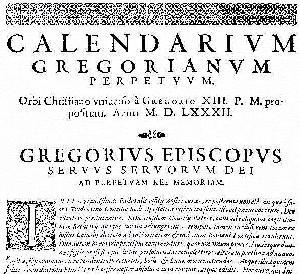
February 29, seems like an appropriate date to discuss the Gregorian Calendar. The Julian Calendar, implemented by Julius Caesar, had been a striking advance for its day, placing the Roman calendar on a solar, rather than a lunar basis, and being only 11 minutes off in the length of the solar year, an astonishingly accurate estimate for the time. However, eleven minutes added up as the long centuries passed, and by the sixteenth century the calendar and the seasons were ten days out of whack, which was important to the Church in regard to the calculation of Easter. The Gregorian Calendar implemented by Pope Gregory XIII in 1582 eliminated ten days from the calendar and instituted the February 29 leap year, ever four years, to compensate for the extra six hours between 365 days and the solar year which adds up each year. Three leap years are skipped every four centuries in years which are divisible by 100 but not divisible by 400. The Gregorian Calendar is off by 26 seconds each year as to the length of the solar year which results in an extra day every 3,323 years.
The introduction of the calendar initially produced confusion in Europe as Catholic States adopted it swiftly while most Protestant States did not. Great Britain and her colonies did not adopt the Gregorian Calendar until 1752, the last country to do so in Europe, except for Sweden in 1753 and the Russians who did not adopt the Gregorian Calendar until the Soviets mandated it in 1918.
https://www.youtube.com/watch?v=-w3P3D9In4g


Early on the Spanish adopted the new, Gregorian calendar. In studying the 1588 Armada campaign we see the English and Spanish dates are off by ten(?).
Much of Eastern Orthodoxy has refused to adopt the Gregorian Calendar, declaring it anathema.